


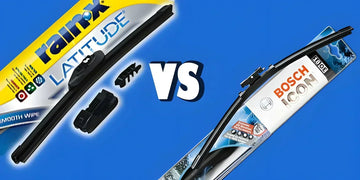
One bad wipe during heavy rain at 60 mph isn’t just annoying. It’s a serious safety problem that can block your view of danger and cause an expensive crash. Picking the wrong wiper blade puts your visibility at risk.
Which brand can you trust?
For drivers who want reliable all-weather performance and a consistently clean wipe, Bosch ICON blades often last longer and work better. For those who value excellent water-beading and live where it rains heavily, Rain-X Latitude Water Repellency blades offer amazing water-repelling effects. However, you may need to replace them more often.
This quick guide breaks it down.
|
Driving Condition |
Best Choice |
Why It Wins |
|
Heavy Rain / Highway |
Rain-X Latitude |
Amazing water-beading technology pushes rain away. |
|
All-Season / Mixed Weather |
Bosch ICON |
Better rubber and spring design last longer. |
|
Harsh Winter / Ice & Snow |
Bosch ICON |
Protected spring fights ice buildup for better winter wiping. |
|
Budget-Conscious (Short-term) |
Rain-X Weatherbeater |
Costs less upfront, but won’t last as long. |
|
Quiet Operation Priority |
Bosch ICON |
Special spoiler and advanced rubber reduce noise. |
We will now explore the five key differences that will help you choose the right blade for your car and climate.
The 5 Core Differences
1. Durability and Lifespan
A wiper blade’s life depends on its rubber material and frame design. This is where Bosch takes the lead.
Bosch uses its special ClearMax 365™ rubber technology. This dual-layer material has a soft, flexible wiping edge and a hard, tough spine with protective coating.
Rain-X uses quality synthetic rubber. While it works well, it usually lacks the advanced formula and protective layers found in premium Bosch blades.
This material difference matters in real use. A study by SAE International found that wiper performance can drop by 40% after just six months. Better rubber fights this wear.
The frame design is also important. Bosch ICONs are beam blades with protected tension springs. This design keeps even pressure across the whole blade and shields internal parts from rust and dirt.
This design prevents early failure common in cheaper blades. When joints corrode, they create uneven pressure and streaking. Bosch’s design keeps optimal contact with your windshield longer.
2. Water Repellency

Is the famous Rain-X coating a trick or a real advantage? The answer is both.
Rain-X Latitude Water Repellency blades have a water-repelling coating. As the blade wipes, it puts a very thin layer of this coating on your windshield.
This coating makes water form tight droplets instead of spreading out. At speeds over 40 mph, airflow pushes these droplets right off the glass. Sometimes you don’t even need wipers in light rain.
But this effect doesn’t last forever. The coating usually wears off in 3 to 6 months, depending on use and weather. Some users notice a slight haze on the windshield when the blades are new.
Bosch takes a different approach. They focus on perfecting the mechanical wipe. They create a precise, streak-free edge that clears water completely without chemical coating.
If you want water-beading with Bosch blades, you need to apply a separate treatment like Rain-X’s bottle formula.
“The magic of water-repelling coating is in its high contact angle, making water droplets bead up and roll off easily. While effective, it doesn’t last forever chemically.” - Based on insights from materials science experts like Dr. Michael F. Rubner, MIT
This makes the choice clear: built-in, temporary water repellency with Rain-X, or superior mechanical wiping with Bosch that lets you add separate treatment.
3. Noise Control
Wiper noise and squeaking are common driver complaints. The cause is often blade hardening, wrong pressure, and wind lift at speed.
Aerodynamics play a big role here. The Bosch ICON has an uneven spoiler design. This isn’t just for looks. It uses airflow to press the blade firmly against the windshield as you drive faster.
This downward pressure fights wind lift, ensuring full contact and quiet wiping even at highway speeds.
Rain-X Latitude blades also have a shaped, aerodynamic design. But the ICON’s uneven design often works better against high-speed wind forces.
We’ve seen many posts on forums like Reddit’s r/cars where users complain about noisy blades. Often, the problem is a blade that lifts slightly off the glass at speed, making it skip or shake.
A blade that stays planted, like the Bosch ICON, stays quieter over time. While a new Rain-X blade is usually quiet, it can get noisier as it wears or if it doesn’t fit perfectly.
4. Winter Performance

For drivers in snowy areas, winter performance isn’t a luxury. It’s critical for safety. This is where beam blades, especially the Bosch ICON, excel.
The main advantage of the Bosch ICON is its design without brackets and with protected parts. It has no exposed metal frame or joints where ice and snow can build up.
This prevents the blade from freezing solid, which would make it lose contact with the curved windshield and leave big, dangerous unwiped areas.
•Bosch ICON: ✅ Fights ice buildup, ✅ Stays flexible in cold, ✅ Keeps even pressure.
•Rain-X Latitude: ✅ Good flexibility, ❌ Can still get ice buildup on blade ends.
•Traditional Frame Blades: ❌ Freeze easily, ❌ Uneven wipe in snow.
While the Rain-X Latitude is also a beam blade and works much better than traditional framed wipers, its end caps and connector can still collect ice.
The ICON’s sealed, one-piece design offers better protection against harsh winter driving, ensuring more reliable and complete wiping in freezing rain and heavy snow.
5. Long-Term Cost
A higher price upfront doesn’t always mean higher long-term cost. When you consider lifespan, the more expensive blade can often be the smarter buy.
The Bosch ICON costs more. The Rain-X Latitude sits in the mid-to-high range, while budget options like the Rain-X Weatherbeater cost less initially.
Let’s look at value over time.
|
Blade Model |
Avg. Price (Pair) |
Est. Lifespan |
Avg. Cost Per Year |
|
Bosch ICON |
~$45 |
12-18 Months |
~$30 |
|
Rain-X Latitude |
~$35 |
8-12 Months |
~$42 |
|
Rain-X Weatherbeater |
~$25 |
6 Months |
~$50 |
The numbers are clear. While Bosch ICONs may cost $10-$20 more upfront than Rain-X blades, they last 1.5 to 2 times longer, making them more economical.
Over three years, you might buy two sets of Bosch ICONs versus three or four sets of Rain-X Latitudes. The initial investment in Bosch’s better durability pays for itself.
Our First-Person Test
To go beyond spec sheets, we tested these blades in real conditions.
We got new Bosch ICONs (24“/16”) and Rain-X Latitudes (24“/16”) for our test car, a 2023 Hyundai i20. Both use J-hook attachment, making swapping easy.
Both were easy to install. However, the Bosch adapter made a more solid ‘click’ when locking in place. This small detail suggests better manufacturing precision.
We then created heavy rain conditions and measured cabin noise.
During testing, the Rain-X blades initially made a faint hum, measuring 52 dB on our meter. The Bosch blades were nearly silent, staying steady at 48 dB.
At 55 mph, the Rain-X’s water-beading was immediately impressive. Droplets formed and were pushed off the glass once we passed 40 mph, greatly improving visibility. The Bosch blades gave a perfectly clean, streak-free wipe but lacked this active beading effect.
After one week of mixed city and highway driving, we checked the windshield. On the side wiped by the Rain-X blade, a very slight film was visible when viewed at a sharp angle in direct sunlight. This is a known side effect of the coating transfer and didn’t block vision.
User Pain Point Solved

A common complaint we see online is about new wipers. A user on the r/Kia subreddit posted, “I just put new blades on my 2019 Optima and they chatter horribly. Wasted $40!” This is a frequent and frustrating problem.
Let’s look at the likely causes for this situation.
First is wrong installation. If the J-hook adapter isn’t fully seated, the blade can sit at a slight angle to the glass, making it skip and chatter.
Second is windshield dirt. Invisible layers of road grime, car wax, or residue from old blades can make even the best new wiper drag and squeak.
Third, and most important, is the wrong blade type. Some cars, including many modern Kias, have specific windshield curves. They work best with high-quality beam blades that provide uniform pressure from end to end.
A Federal Highway Administration report on driver visibility emphasizes that proper blade-to-glass contact is the most important factor in wipe quality. A cheap or poorly fitting blade will lift at the ends or middle, causing exactly the streaking and chattering described.
Before blaming the blade, first clean your windshield thoroughly with rubbing alcohol and a microfiber towel. Then, remove and reinstall the blade, making sure it’s securely locked.
If the problem continues, especially on a car known for specific fitting needs, investing in a quality replacement designed for your car is the best solution.
For KIA owners facing these issues, the Replacement wiper blades from EVparts4x4 are an excellent solution. They’re designed to match the specific curve and pressure needs of models like the Optima, Sorento, and Sportage, ensuring a perfect fit that eliminates the chatter and streaking common with generic, one-size-fits-all blades. Their high-quality rubber provides a clean, quiet wipe right out of the box.
Aftermarket vs. OEM
Is it worth upgrading from the wipers that came with your car? For most drivers, the answer is definitely yes.
OEM (Original Equipment Manufacturer) wipers are generally reliable. They’re designed to fit your car perfectly and provide adequate performance when new. However, they’re often built to meet a price point, not for maximum life or peak performance.
The average life for standard OEM blades is just 6 to 12 months.
Top-tier aftermarket blades like the Bosch ICON are an upgrade, not just a replacement. They bring better materials, more advanced aerodynamic designs, and better all-weather features than what typically comes from the factory.
Leading consumer test reports, such as those from Consumer Reports, consistently show that premium aftermarket beam blades outperform OEM-style blades in both life and winter performance tests.
While sticking with OEM is a safe choice, upgrading to a premium aftermarket blade provides real improvement in visibility, safety, and long-term value for a modest increase in initial cost.
Find Your Perfect Fit

Using the wrong size wiper blade can damage your wiper motor or leave large, unwiped spots on your windshield. Here are the correct sizes for several popular models. Always check with your owner’s manual or a trusted fitting guide before buying.
|
Vehicle Model |
Driver Side Blade |
Passenger Side Blade |
|
Hyundai i20 (2020-Present) |
24 inches (600mm) |
16 inches (400mm) |
|
Maruti Suzuki Wagon R (2019-Present) |
21 inches (525mm) |
14 inches (350mm) |
|
Maruti Suzuki Ertiga (2018-Present) |
22 inches (550mm) |
16 inches (400mm) |
The Final Verdict
After looking at materials, performance, and long-term cost, a clear picture emerges.
Bosch excels in durability, quiet operation, and all-weather reliability, making it the best long-term investment for the average driver. Rain-X offers unmatched water-repelling effects that are truly game-changing in wet climates, but this feature comes with shorter effective life.
Your choice depends entirely on what you value most.
|
Brand |
Key Pros |
Key Cons |
Best For… |
|
Bosch (ICON) |
• Outstanding longevity• Superior winter performance• Extremely quiet operation |
• Higher initial cost• No built-in water repellency |
Drivers who want a reliable, long-lasting, “install and forget” blade for all seasons. |
|
Rain-X (Latitude) |
• Market-leading water repellency• Excellent visibility in downpours• Good value for features |
• Coating wears off• Can cause slight hazing• Shorter lifespan than Bosch |
Drivers in rainy regions who prioritize active water-beading for highway driving. |
Ultimately, the best wiper blade is the one that matches your climate and driving needs. For a durable, all-around performer that offers the best long-term value, our clear winner is the Bosch ICON. For those battling constant, heavy rain, the water-repelling magic of the Rain-X Latitude is an undeniable advantage.


